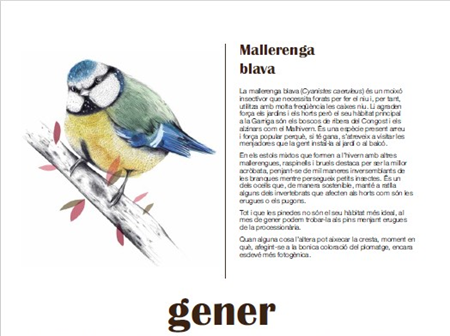
The 2026 calendar is once again dedicated to the fauna of La Garriga, taking into account the natural cycle of species throughout the year.
Each animal has been chosen for the month in which it arrives in our territory, is easier to observe or presents a characteristic behavior, such as migration, reproduction, singing, etc.
The calendar invites us to look at nature with attention and respect, understanding that fauna follows the rhythm of the seasons. Observing these animals each month helps us to know our environment better and to understand the importance of protecting it.
In winter, birds such as the blue tit (for the month of January) and the smoky tit (December) play a fundamental role in the natural control of insect pests, helping to keep forests, orchards and gardens healthy. Their presence indicates relatively well-preserved environments and a good coexistence between fauna and humanized spaces.
With the arrival of good weather, we can see insects such as the lemon butterfly (February) and the aurora butterfly (April), seeing them tells us about the good health of the scrublands, streams and humid depressions. In addition, they contribute to pollination, a key process for plant biodiversity.
Migratory birds such as the swallowtail (March) and the bee-eater (May) connect the Garriga with other distant territories. The fact that they return year after year demonstrates the importance of conserving breeding areas, slopes, farms and open areas. These birds help regulate insect populations and are an excellent indicator of environmental changes and the agricultural landscape.
Amphibians such as the totem (June) directly alert us to the quality of water and soil, as they are very sensitive to pollution and the disappearance of small ponds. Protecting them involves conserving water points, banks and natural spaces that are often underestimated but essential.
More discreet species, such as the common toad (July) or the greenfinch (October), indicate the maturity and complexity of forest ecosystems. They need forests with dead wood, wetlands and quiet corners that often disappear with excessively intensive forest management.
Mammals such as the badger (September) and the squirrel (November) contribute to the dynamics of the forest and soil: they dig, disperse seeds and help renew the territory. In addition, their presence in a mosaic landscape, such as that of La Garriga, highlights the importance of maintaining the diversity of habitats and ecological connectivity.
The fauna of La Garriga is a reflection of the richness and balance of its Mediterranean ecosystems. Each species, throughout the year, fulfills an essential function that contributes to the proper functioning of the territory, and its protection is key to maintaining this balance.
You can find the 2026 calendar of La Garriga at the offices of the Local Police, the OAC, the Núria Albó Library and the Visitor Center.